ORGANIC MUSIC

Always Human. Never AI.

The Resistance Starts with a Single Note

A guide to understanding, supporting, and choosing 100% human-made music.

Collapse All
Expand All
What is Organic Music?

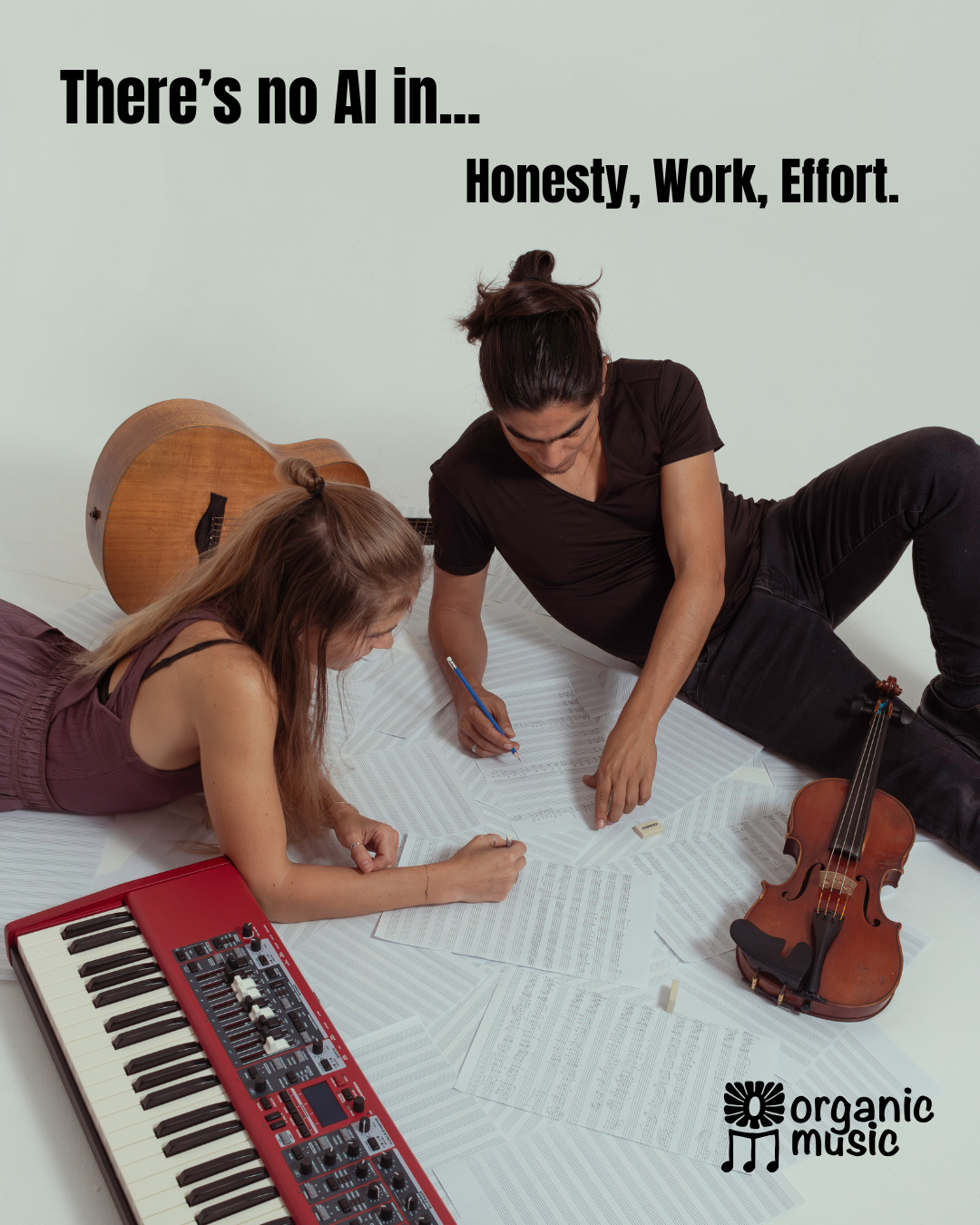
Organic Music is a philosophy and a way to create music. Amidst the impending rise of artificial intelligence, we are a movement putting humans first, upholding effort, emotion, and creativity as irreplaceable attributes of music-making.

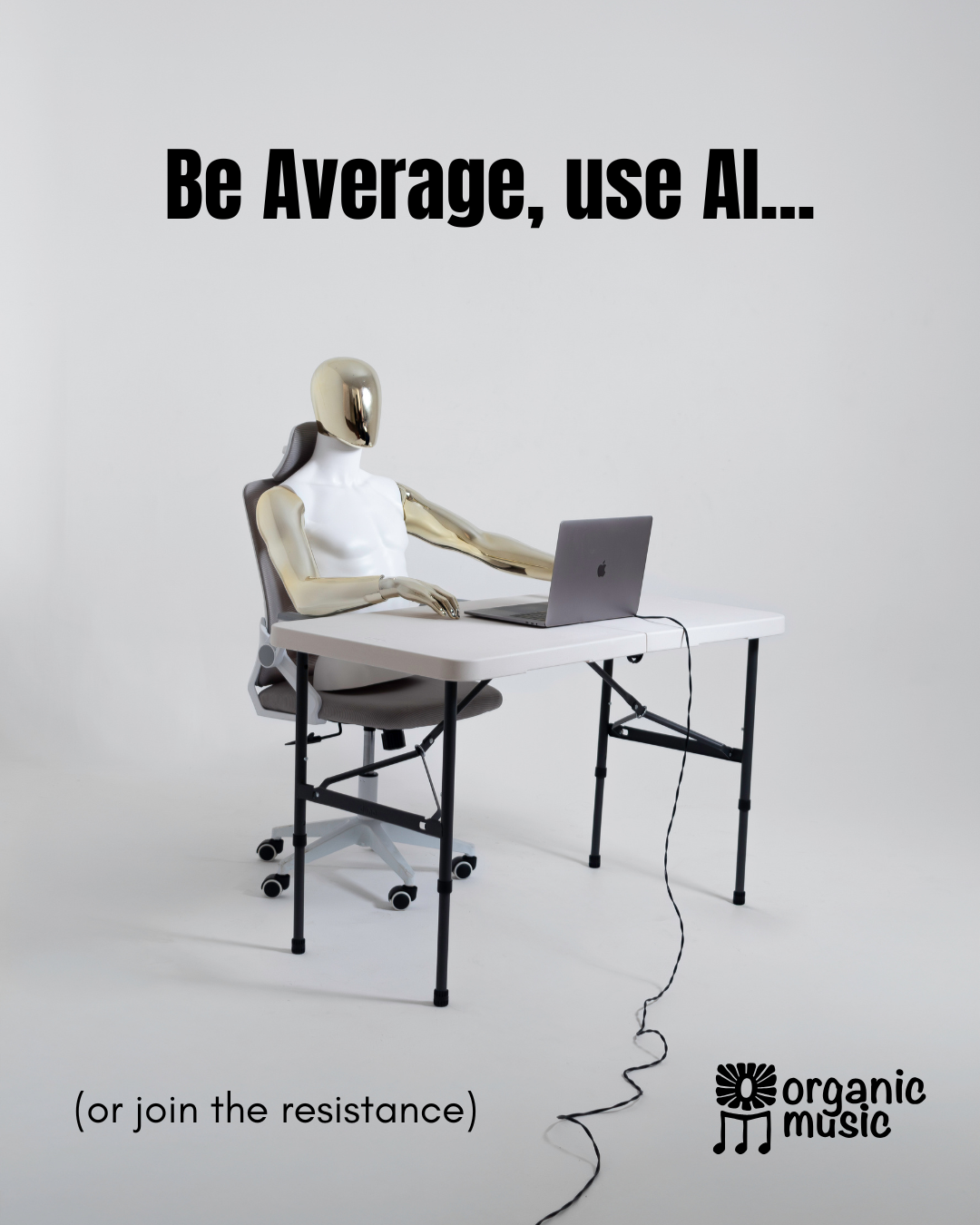
Organic Music rejects the use of generative AI during any part of the creative process, while educating people about the importance of supporting real artists, and the many benefits that choosing Organic Music brings to our society.

What makes Organic Music “organic”?

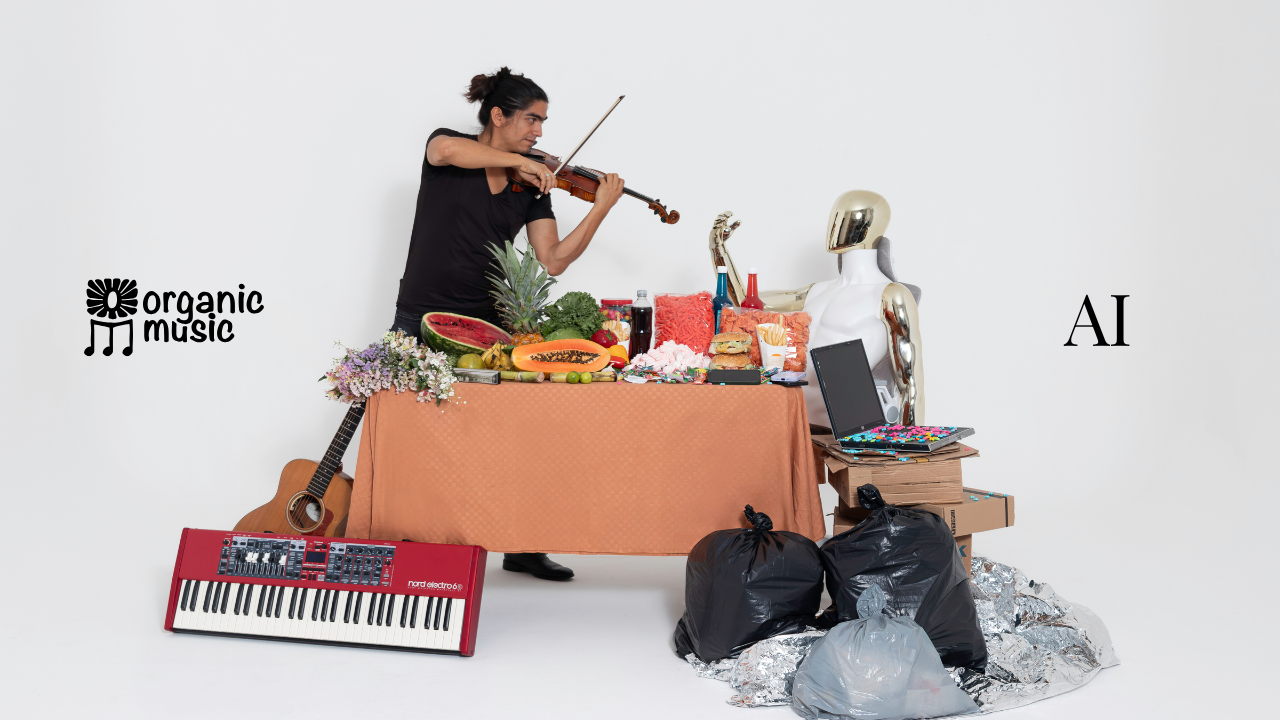
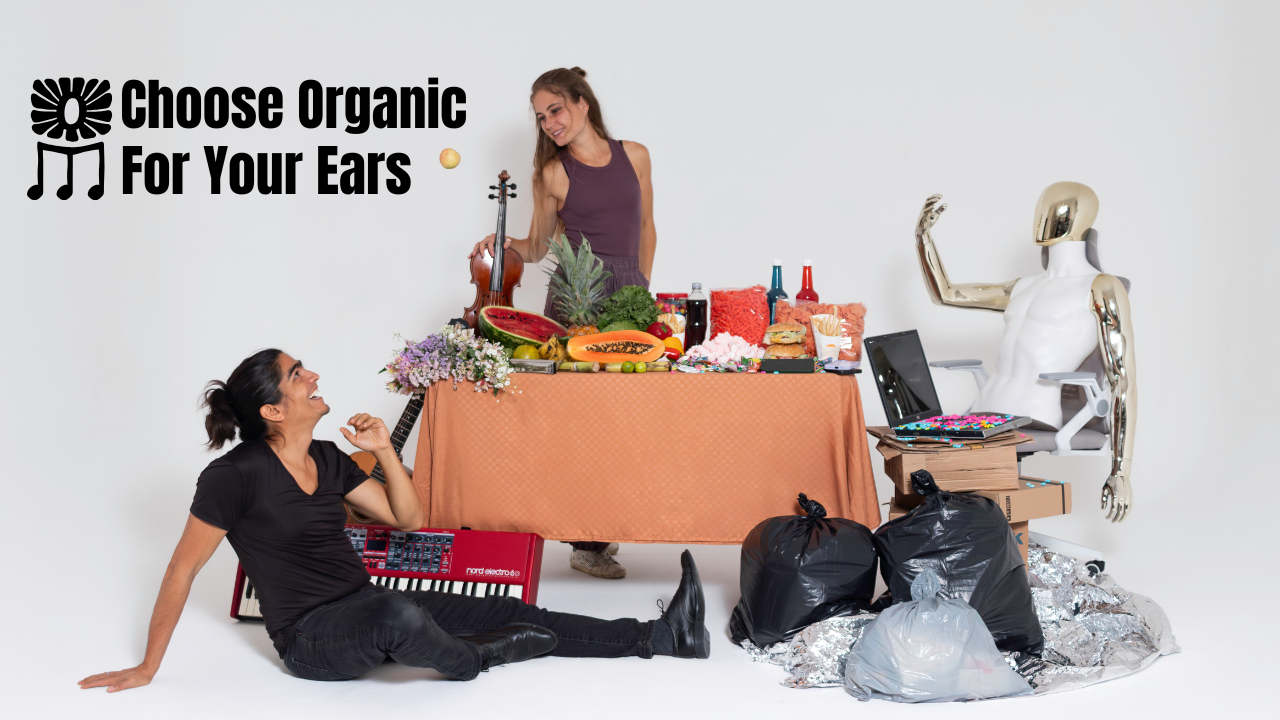
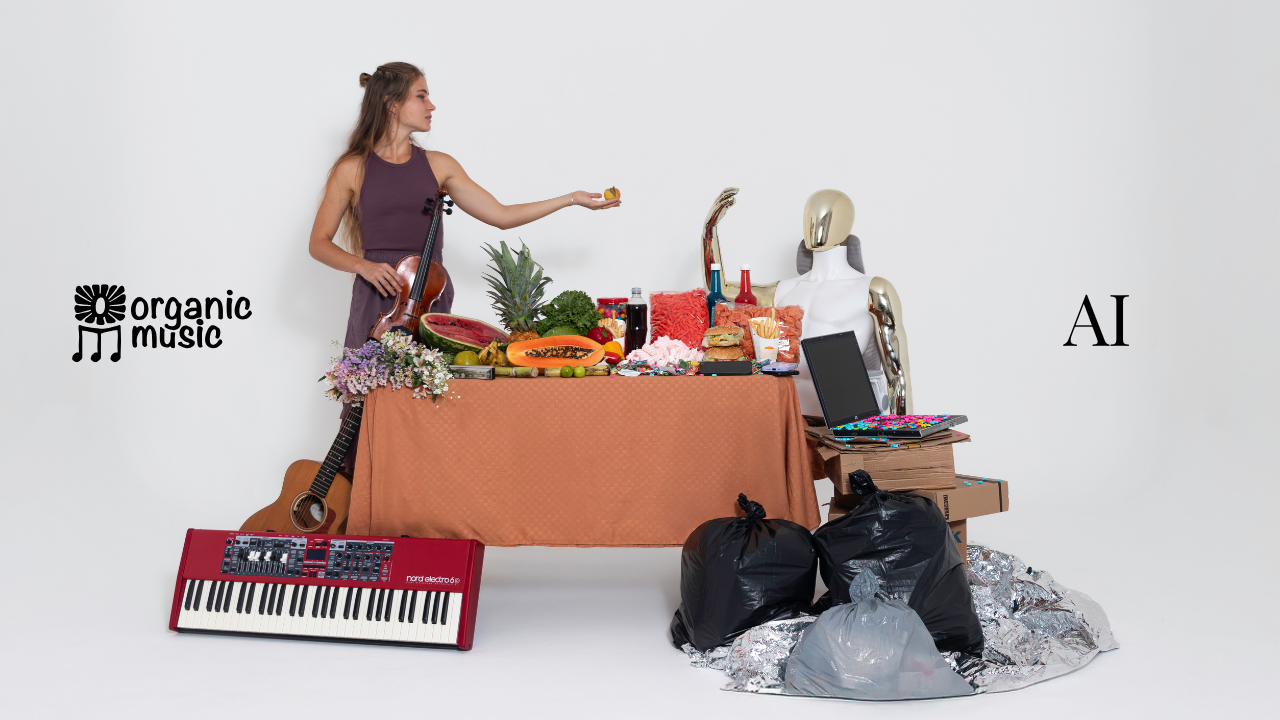
You can think about Organic Music in the same way you think about organic food: It’s free from artificial colorings, preservatives, and made with love and effort using only the best natural ingredients. Throughout the entire process of composing and releasing a song, or an album, Organic Music rejects the generative use or the assistance of artificial intelligence.

From designing the artwork to writing the lyrics; composing harmonies and melodies; recording, mixing, and mastering; every care is taken to make sure that real artists and musicians are not losing their jobs to AI. Organic Music is about guaranteeing that every note and every word in the final product comes from the heart and the mind of a real person, not an algorithm.

Why is Organic Music important?

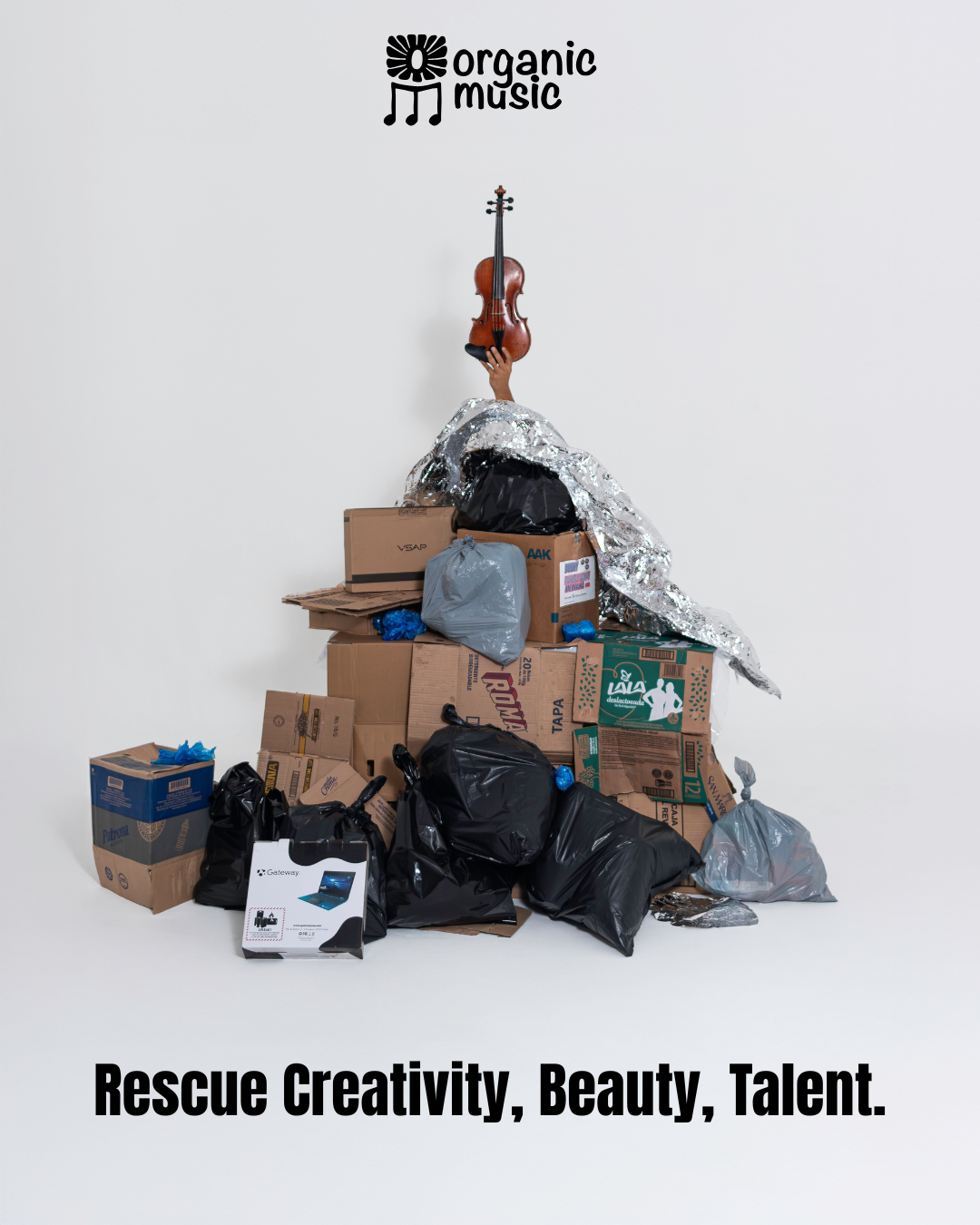
Because real music — made with effort, time, and emotion — is at risk of disappearing. The boom of artificial intelligence is devouring everything, like The Nothing in Never Ending Story. In the book (and the movie), Fantasia is dying because humanity no longer uses its imagination.

The analogy could not be more appropriate and urgent today. We seem eager to delegate everything to AI, including thinking and creating, and if we do, something essential about being human will be lost. Organic Music is about preserving one of the defining human traits: our creativity. It’s about realizing that music is much more than mere entertainment. It's about building a society that cherishes the hard work of musicians, and supports the talent it takes to create something from nothing.

Artificial intelligence sell us the idea of a smooth and frictionless reality, one in which we don’t have to do anything. Organic Music believes that growth — both physical and spiritual — only happens when we have the discipline to maintain effort and overcome challenges.

How exactly is artificial intelligence being used to generate music?

There isn’t a single aspect of creating music that is not being targeted by artificial intelligence. As a matter of fact, there are some apps today that generate radio-ready songs in seconds. As the advertisement for one of these apps puts it: “You blink... and something that didn’t exist before now does. [...] without waiting, without wondering if you are capable.”

Many people don’t realize this, but today it’s entirely possible to release an album without involving a single musician. Anyone is able to prompt the latest AI and “write” perfectly rhymed lyrics in the blink of an eye. A person with no musical education can “compose” a chord progression, a bass line, and a catchy melody instantly; without ever playing a note. Virtual instruments can perform by themselves, replacing all sort of musicians, even singers. Mixing and mastering engineers can also be easily substituted. On the visual side of production, graphic designers and photographers — who used to be employed for album design and promotion — are no match for the speed and minimal cost of AI. Once a song is finished, the exponential improvement in the realism of deepfakes, makes it possible to generate AI music videos in a few seconds; replacing the jobs of millions in the music video industry. It is now also possible to create virtual artists — forever young and flawless — and in the future, it will be nearly impossible to tell them apart from real humans.

Why should I care about listening to Organic Music?

You probably wouldn’t eat junk food every day. And if you did, there would be direconsequences for your health. In a similar way, continuous exposure to artificially- generated music is depriving you of subtle but essential musical “nutrients”.The passion, wisdom, and effort that go into composing music are not measurable by science. But for us musicians, it is no secret that these are undeniable attributes of real music. We imbue them slowly into our melodies, and you absorb them as you listen. There was a time when people didn’t care much for the quality or the provenance of the food they consumed. It took time and a collective effort to raise awareness about the risks involved in processed foods, and the many benefits of eating organic.

The side effects of being overexposed to a “diet” of AI-generated music are not known (yet), but we do know that becoming a musician and listening to Organic Music has transformed lives, improved well-being, and inspired millions throughout history. Today, we demand to know what is inside our food, because we understand the difference. With Organic Music, we are trying to raise the same type of awareness, but for the music we consume.

We only care for what we know. So, in order to highlight the importance of music made with human hearts and souls, we are unmasking the artificial processes behind some of the music that we listen to. Through education, we hope that people will once again cherish the authenticity that comes from the slow — and sometimes flawed — process of creating music the “organic” way.

In summary, you should care because you are what you eat...and what you listen to.

What is wrong with using artificial intelligence to generate music?

Nobody likes a bully. Artificial intelligence is not an abstract concept. It is the product of billionaire companies looking for a new way to profit at a global scale. AI is the new neighborhood bully, pushing musicians, artists, creatives, and workers of all kind away. The origin-story of generative AI is ethically corrupt. The billionaire companies behind it used the copyrighted music, art, and literature of millions of artists to train their algorithms, and they did it years before the world was ready to protect the authors through strong legislation. When it comes to music and art, there is nothing original about artificial intelligence. It is a mishmash of stolen talent.

As bad as this sounds, it is not the whole story. There is also the millions of endangeredl ivelihoods, and the alarming possibility of less and less young people undertaking the life-changing process of becoming a musician (or an artist). Learning any craft requires focus, time, and effort; and in the case of music, it develops intelligence, sensitivity, and creativity. In order to become a musician, you must overcome internal battles against fear, laziness, and doubt; all while maintaining discipline and developing courage. In other words, music is good for the world not only because it produces musicians who in turn entertain us, but because it produces better human beings. Whether you become a professional or not, the values and skills that you develop as a musician carry over and can be applied to many aspects of life. With the rise of artificially-generated music, we face the very real possibility of more people forgoing their imagination and choosing to avoid creative effort. It is easier to think of music as something that can be finished in one afternoon, than as a life-time commitment. And with today’s AI anyone can deceive themselves and bask in the instant gratification of feeling like an “artist”, or a “composer”.

Proponents of artificial intelligence say that it speeds up productivity, freeing humans to do more. Why is this misleading?

If a form of artificial intelligence frees people from a meaningless and repetitive task, granting them more time to do something creative — and assuming that their livelihood is not endangered in the process — then, we welcome it. But that is not what is happening. Artificial intelligence is the product of billionaire companies whose goal is to secure as many subscribers as possible to their AI at any cost. The philosophy of Organic Music is that artificial intelligence has no place in the creative process of people, and that using it for this purpose is, in fact, detrimental to humans.

Every activity that requires us to imagine and to sustain creative effort should be encouraged and cherished, not delegated to AI. Many people think that by using AI they are being smarter and faster than everyone else. But the opposite is true. Even though we are told by the AI masters that we will be more efficient and productive, every time we allow AI to deprive us of our capacity to dream, to innovate, and to create; we become a little bit less intelligent, a little bit less resilient, a little bit less human. The danger with AI is how efficiently it exploits our tendency to succumb to instant gratification. We must think longterm. What kind of person will I become in the next 10 years if I continue to read, to write, to look for my own solutions, to welcome friction and difficulty in the process of learning?
And who will I become if I delegate all of this to AI instead?

Artificial intelligence is the future and it is here to stay. Aren’t you fighting a lost battle?

We understand that the rise of artificial intelligence is unstoppable and we are not here to try to prevent it. Our resistance is about protecting creativity as a defining human trait, and making sure that people have all the knowledge they need to make an informed decision regarding the type of music they choose to listen to.

When plastic became a mainstream commodity, people said it was the material of the future; unbreakable, cheap, easy to clean, etc. Fast forward a couple of decades and plastic — and microplastics — have become a liability for the planet and almost the villain of our story. Sure, there are still undeniable uses for plastic today, but we have seen a hopeful resurgence of organic materials like clay, wood, and glass.

People prefer them precisely because they are imperfect, breakable, and handmade. In a similar way, we are sure that there will be many appropriate uses for artificial intelligence; but replacing creativity should not be one of them. Even though we might be a minority at this moment, we are confident that there are many people who are also starting to feel uneasy about delegating our thinking and imagination to artificial intelligence. We hope that Organic Music becomes an amalgamating philosophy; acollective umbrella under which artists and like-minded people can gather to support authenticity, effort, and talent.

Why is faster not always better?

The idea that faster equals better only makes sense in a competitive society that values productivity, money, and efficiency over everything else. To be fair, that is the kind of world that we live in today. But it is far from the world we would like to live in. It is easy to come up with examples that expose the faster-equals-better formula as incomplete at best. When you are lucky enough to catch a spectacular sunset, would you like it to elapse faster? What about spending precious time with a loved one? Or life itself — the time that we are given on this planet — would you like to speed it up in the name of efficiency?

These days, we value the speed of getting from one place to another; so we drive and we fly to optimize our travel. But even here, it’s worth questioning if speed is, indeed, more valuable than the experiences and details that we miss in our obsession to get there sooner. What if a bike ride or a walk were the true treasures of the day? There are things that simply cannot be rushed without being destroyed. Good food is a great example. Once in Marrakech, we ate lamb cooked underground for several days, and it is until this day the best one we have ever tried. We are sure all of you have similar stories. Organic Music claims that learning and creating music is such a process. One that cannot be “optimized” and sped up by artificial intelligence without losing its essence. Good music — like a good meal — cooks slowly. And there is value and wisdom in that.

So...are you against the use of technology?

Not at all! We encourage the use of any technology as long as it is serving humanity, not replacing human imagination and creativity. A couple of examples should be useful here:

Say you prefer using a laptop or your phone to write and edit the lyrics of a new song, rather than using pen and paper. No problem there. But let’s say you want to use the latest AI to finish the lyrics faster, so you prompt it with something like: “Write the lyrics for a song, with a verse-prechorus-chorus structure. Make it about a boy that keeps getting hurt in his relationships because he is not able to let go of the memory of his first love”. This would never be considered Organic Music, because the lyrics of the song are not the work of a human, and are devoid of effort, authenticity, and feeling.

The same would apply for using AI to create the musical structure of a song (harmonies and melodies), or replacing the performances of real musicians with automated AI-players.This second example is more technical, and is meant for musicians and producers. Let’s say that you own a collection of virtual instruments. You use them because you like the unique sounds that would be otherwise impossible to produce in the physical world. Or perhaps, you use scoring software to compose your music, export it as MIDI, and import into your DAW as notes to be played by your virtual instruments (or program them directly). No problem with any of this, because it is still you who is doing the thinking and the composing work.

But now, let’s say that you are using pre-composed MIDI packs for your virtual instruments, or pre-recorded loops, or an AI drummer, guitarist, or bassist, that is playing lines automatically. None of this would qualify as Organic Music, because it is not the work of a human.The same applies to any AI-based mixing and mastering procedures where the decision- making is delegated to software.

I listened to a song and liked it, only to be told that it was generated by artificial intelligence. If I cannot tell the difference, why should I choose Organic Music?

For decades, the behemoth companies that developed artificial intelligence trained their models away from the public eye in an unregulated environment. So, it is very likely that AI will continue to improve, and that in the near future it will be capable of generating music that is indiscernible from human compositions. After all, it was trained on the entirety of humanity’s artistic output. It is already happening with popular music (as you have experienced), but it will soon happen in classical music and jazz as well.

We think it is entirely possible that artificial intelligence will be able to generate symphonies that rival those of Mozart and Tchaikovsky in seconds, perhaps hundreds of them. Instead of years of diligent piano practice, it will take AI-Herbie Hancock a millisecond to generate multiple solos for “Giant Steps”. Eventually, artificial intelligence will be able to perform those pieces without the need of any human as well. Why then, should you choose Organic Music? To answer this, let’s look at chess history: In 1996, IBM’s computer, Deep Blue, defeated the then World Chess Champion, Garry Kasparov. It was a significant moment and a sign that artificial intelligence was catching up to human intelligence.

Since then, computers and AI have advanced exponentially and today, no human stands a chance against a chess computer. And yet, chess has not disappeared or become obsolete. Why? Because like in music, becoming a chess Grand Master is a life-time commitment that requires discipline and sustained effort. That work has immense positive and measurable consequences in the development of a person, and we admire those who undertake it. We engage in sport, in dance, in chess, and in music, not to defeat or to be faster than a computer, but to have fun, grow, and evolve as humans.In addition, when you choose Organic Music you are choosing more than just music.

Composers put a part of their life into it. You are getting authenticity, real experience, and emotion; told through years of hard work and dedication. AI-music will never have meaning or purpose, because it doesn’t love and it doesn’t cry. It knows no empathy, nor indignation. Yes, it can sound the same, and even be more perfect than the original; but so is an artificial flower. Organic Music will always be relevant, because music is much more than a product for our entertainment. It is an essential part of what it means to be human.


So...what about classical music and jazz. Are they Organic Music?

They can be! But sadly, these days they can also be completely generated by artificial intelligence.

If you are a classical or a jazz musician, you know first-hand the persistence and effort it takes to master your craft. However, it is only a matter of time before AI becomes faster and more precise than any human performer. Therefore, we are inviting musicians in these genres to do the one thing that AI will never be able to take from them: imagine and manifest truly original music. To be clear, AI-generated music ≠ an original composition. It’s a pastiche of stolen work, scrambled in a way that seems original in order to justify its lack of accountability and blatant copyright infringement. In summary, as long as they are free from artificial intelligence, jazz and classical music are Organic Music. And we would love it even more if the pieces were new and original, instead of covers and arrangements.

I want to make sure that the music I am listening to is Organic; where can I find it?

Great news! We’ve created an Organic Music Playlist on Spotify, filled with fantastic musicians who understand the importance of our mission. Ranging from up-and-coming bands to multi-Grammy-winning artists, you have enough material to listen for hours. And you can feel good about it too! By listening to this music you are making a positive difference in the lives of these artists.

We are constantly updating the playlist to give exposure to new artists and to keep your content fresh. Check it out and save it to your library; the more you listen, the more you help the Resistance!

I am a musician already following the principles of Organic Music; how can I get featured on the Organic Music Playlist?

It’s easy! Click here, or on the “Apply” button at the top of this page. Answer a few questions about your creative process, share your music with us, and we’ll be in touch soon!

I like what I hear about Organic Music, how can I best support the movement?

The most significant ways in which you can help Organic Music are: education and support. If people don’t understand the value of Organic Music, it will be difficult to keep it alive. Therefore, we must spread awareness of Organic Music as much as possible, while supporting the musicians who create it.

On the education and awareness side of things, you can:

Share our website (organic-music.com) with everyone you know!

Follow us on Instagram (@loboluna.official) and tag us in relevant materials to strengthen the resistance!

Start conversations with your friends and family about Organic Music and the importance of human creativity.

If you are a teacher, bring the topics of Organic Music and creativity into the classroom.

If you are a music teacher, encourage your students to ditch artificial intelligence and choose organic means to compose and record their music.

Learn a musical instrument or encourage your children to do so.

Join our mailing list to stay in the loop and grow a network of like-minded people

Ways in which you can support Organic Music:

Make yourself an ambassador of Organic Music! Visit our store and consider buying one of our fun products to show the world what you stand for — creativity, imagination, and authenticity.

Save the Organic Music Playlist to your library on Spotify and share it! Composing music in an organic way takes a lot of effort and time, andmany musicians are tempted to start using artificial intelligence to “create”, because their financial situation is dire. Your support makes it possible for them to continue making Organic Music.

Put your money where your values are! Support the artists and musicians committed to Organic Music; attend their shows, buy their music and their merchandise, share their socials.

Invite us, Lobo & Luna, to deliver a keynote at your community, school, or university about the importance of human creativity, the dangers of artificial intelligence, and the benefits of Organic Music.

If you are a musician already following the principles of Organic Music, get in touch with us to join our growing playlist of Organic Music Artists.

If you are a programmer or a computer engineer, you can help us by developing software to protect new musical compositions and prevent their unauthorized use in artificial intelligence training.

If you are a politician or an activist, help us pressure our representatives to enact transparent legislation that allows human creators to protect their work from being used to train AI models.

Stay in the Loop

Sign up for fresh releases, videos, and exclusive content—straight from Lobo & Luna.

Thank you! Your submission has been received!
Oops! Something went wrong while submitting the form.